


Phone
Email
Address
:
:
:

English
English - English
Khmer - ខ្មែរ
Chinese - 中文
English - English
Khmer - ខ្មែរ
Chinese - 中文


Investing in Legitimate Investment Products
According to published figures by the World Bank, Cambodia's GDP per capita has risen from US$783 (2010) to US$1,625 (2021). Statista.com projected that its GDP will continue to grow to approximately US$2,656 by 2028. The growth in the middle income and increase in wealth of the average Cambodian will naturally bring about the need for investing. However, recently we have also seen a spike in cases of reported fraudulent and failed investment schemes, as well as some which are outright scams.
When investing, investors are traditionally enticed by high returns and a sense of familiarity. Very often they ignore what is perhaps the most important factor when investing, which are the risk factors.
Risk comes in many forms, to name a few:
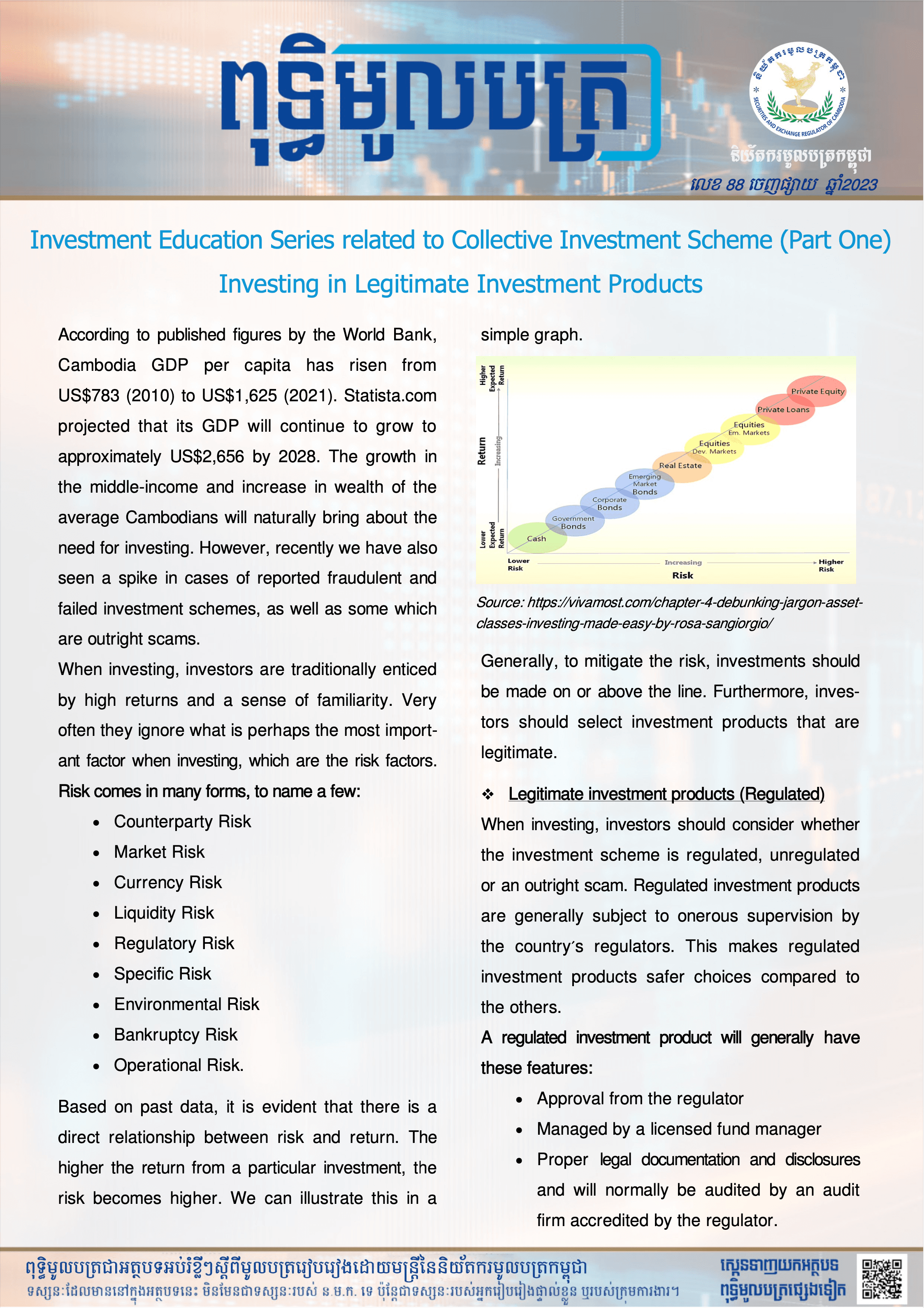
Based on past data, it is evident that there is a direct relationship between risk and return. The higher the return from a particular investment, the risk becomes higher. We can illustrate this in a simple graph.
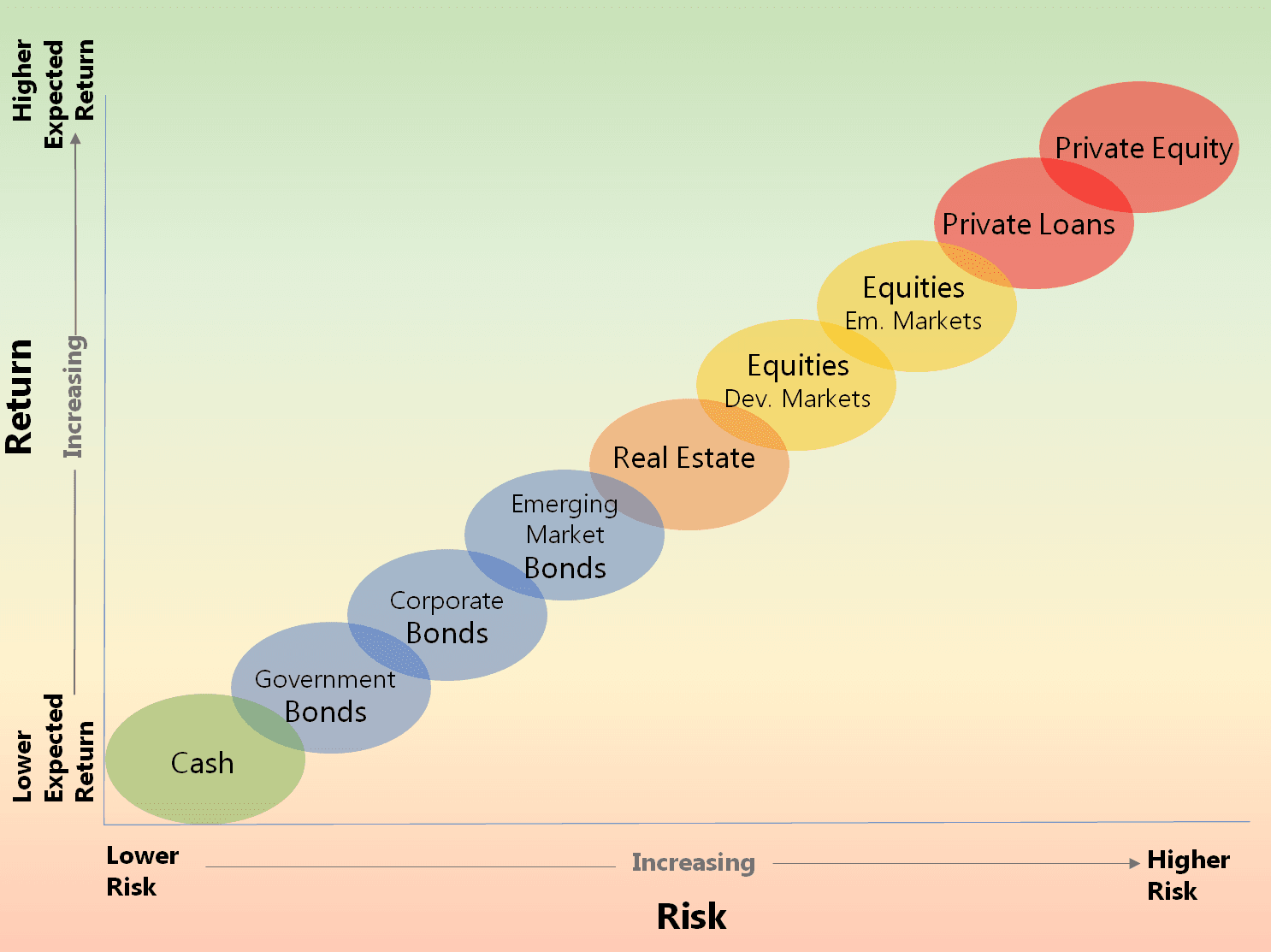
Generally, to mitigate the risk, investments should be made on or above the line. Furthermore, investors should select legitimate investment products.
❖ Legitimate investment products (Regulated)
When investing, investors should consider whether the investment scheme is regulated, unregulated, or an outright scam. Regulated investment products are generally subject to onerous supervision by the country’s regulators. This makes regulated investment products safer choices compared to the others.
A regulated investment product will generally have these features:
Therefore, the risk of a regulated investment scheme being a fraud is very low.
❖ The update of the Cambodia Collective Investment Scheme Market
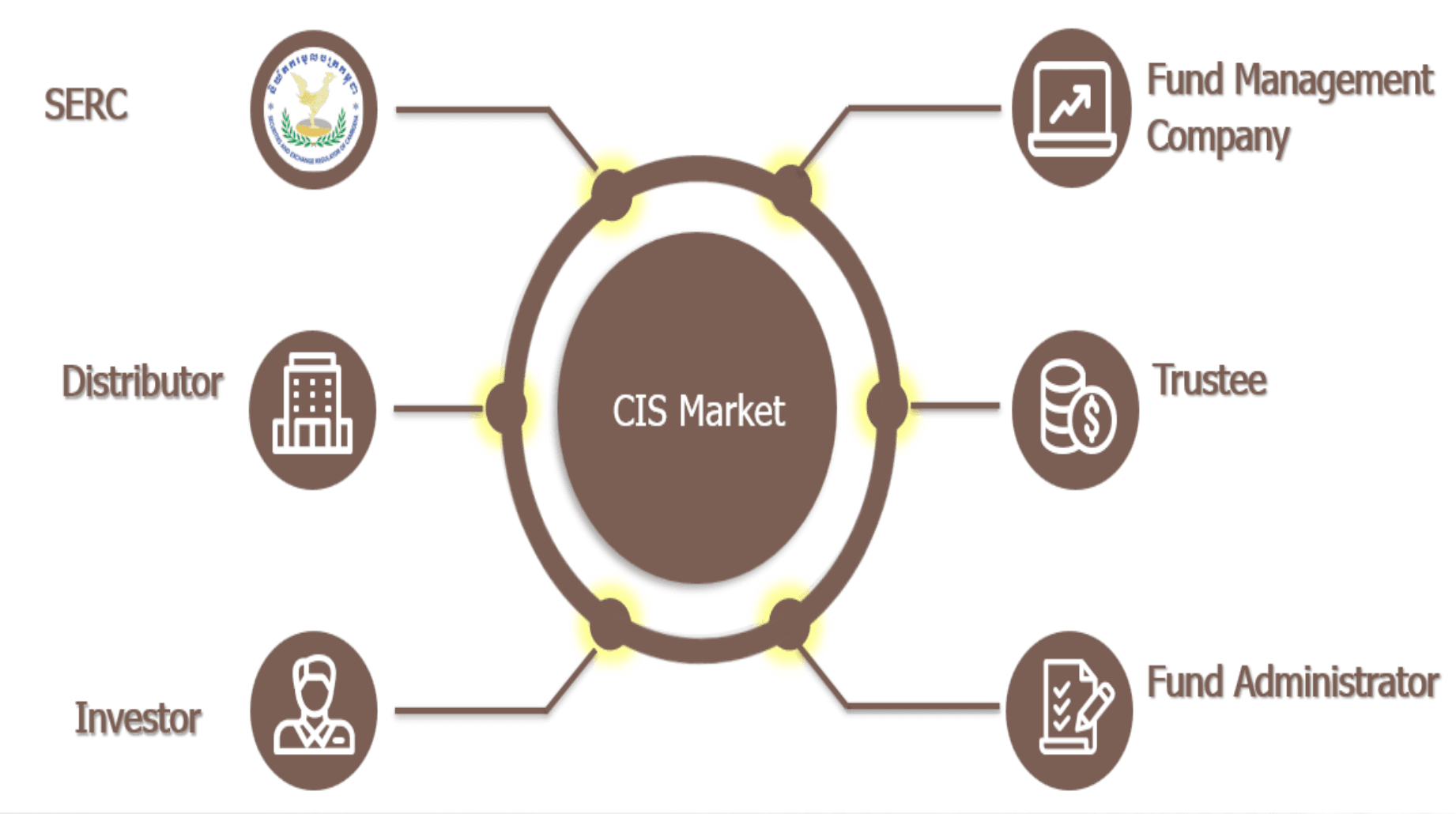
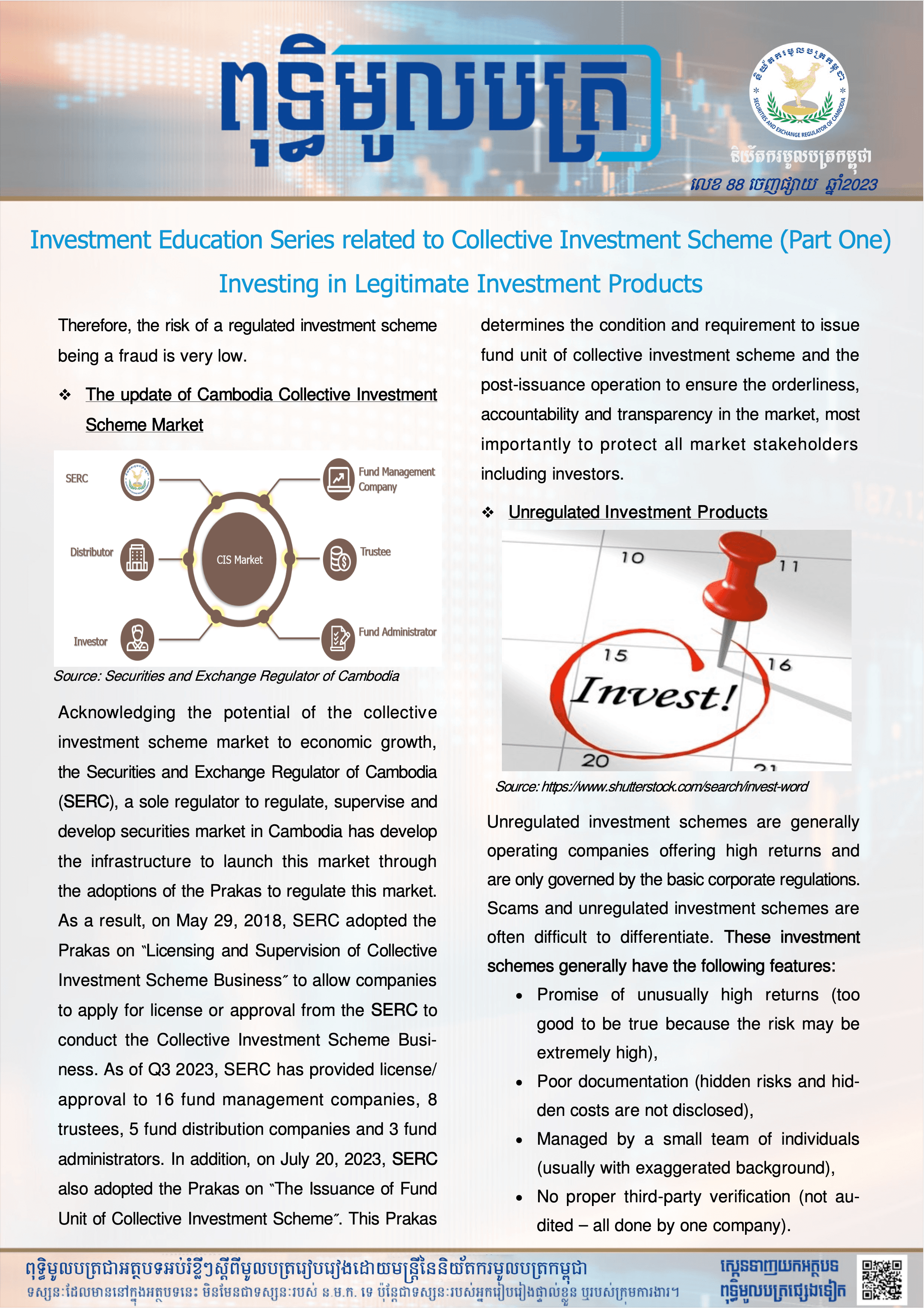
Acknowledging the potential of the collective investment scheme market for economic growth, the Securities and Exchange Regulator of Cambodia (SERC), a sole regulator to regulate, supervise, and develop the securities market in Cambodia has developed the infrastructure to launch this market through the adoption of the Prakas to regulate this market. As a result, on May 29, 2018, SERC adopted the Prakas on “Licensing and Supervision of Collective Investment Scheme Business” to allow companies to apply for a license or approval from the SERC to conduct the Collective Investment Scheme Business. As of Q3 2023, SERC has provided license/approval to 16 fund management companies, 8 trustees, 5 fund distribution companies, and 3 fund administrators. In addition, on July 20, 2023, SERC also adopted the Prakas on “The Issuance of Fund Unit of Collective Investment Scheme”. This Prakas determines the condition and requirement to issue fund units of the collective investment scheme and the post-issuance operation to ensure the orderliness, accountability, and transparency in the market and, most importantly to protect all market stakeholders including investors.
❖ Unregulated Investment Products

Unregulated investment schemes are generally operating companies offering high returns and are only governed by the basic corporate regulations.
Scams and unregulated investment schemes are often difficult to differentiate.
These investment schemes generally have the following features:
❖ Scams or Fraudulent Investment Schemes
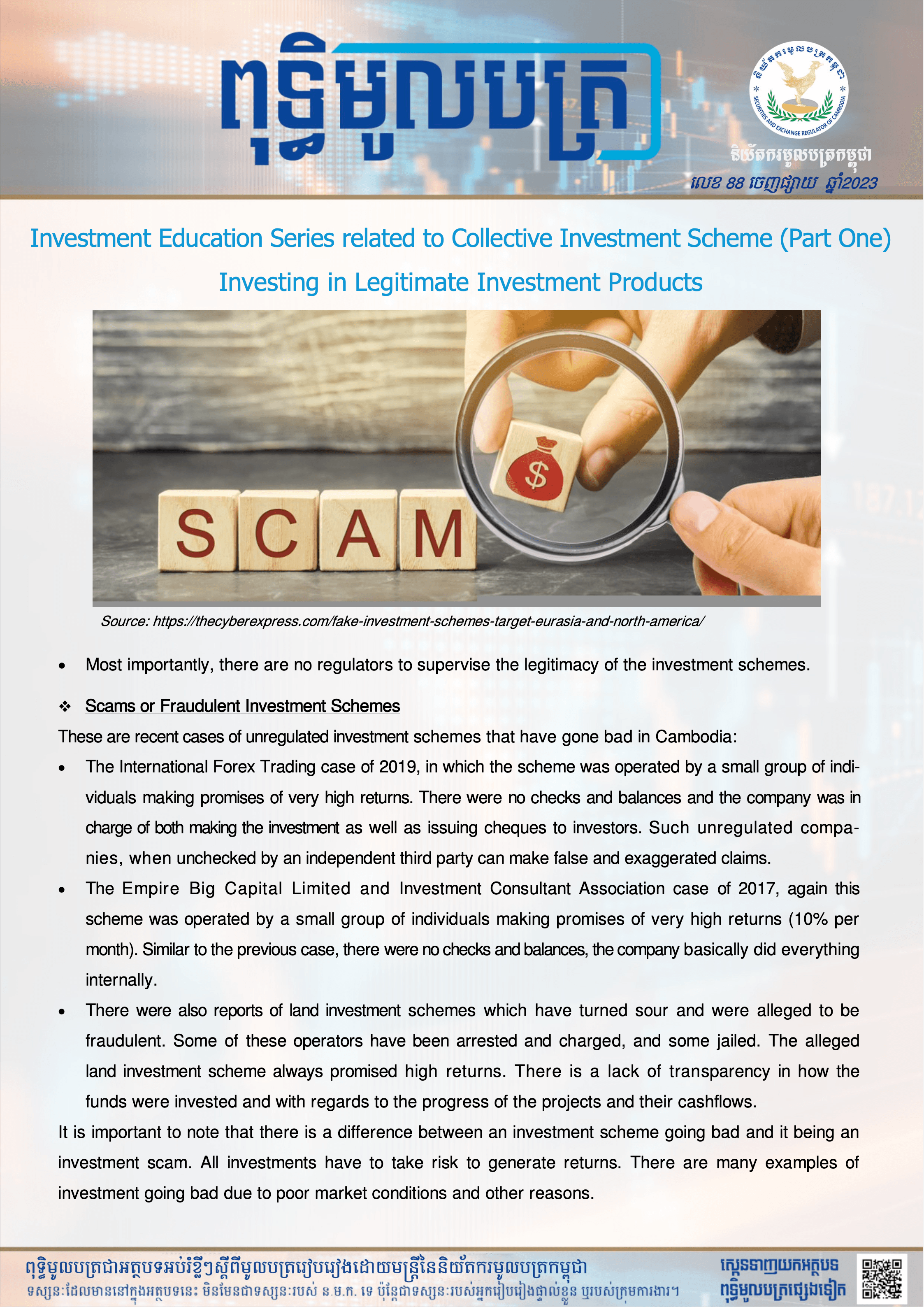
These are recent cases of unregulated investment schemes that have gone bad in Cambodia:
It is important to note that there is a difference between an investment scheme going bad and it being an investment scam. All investments have to take risks to generate returns. There are many examples of investments going bad due to poor market conditions and other reasons.
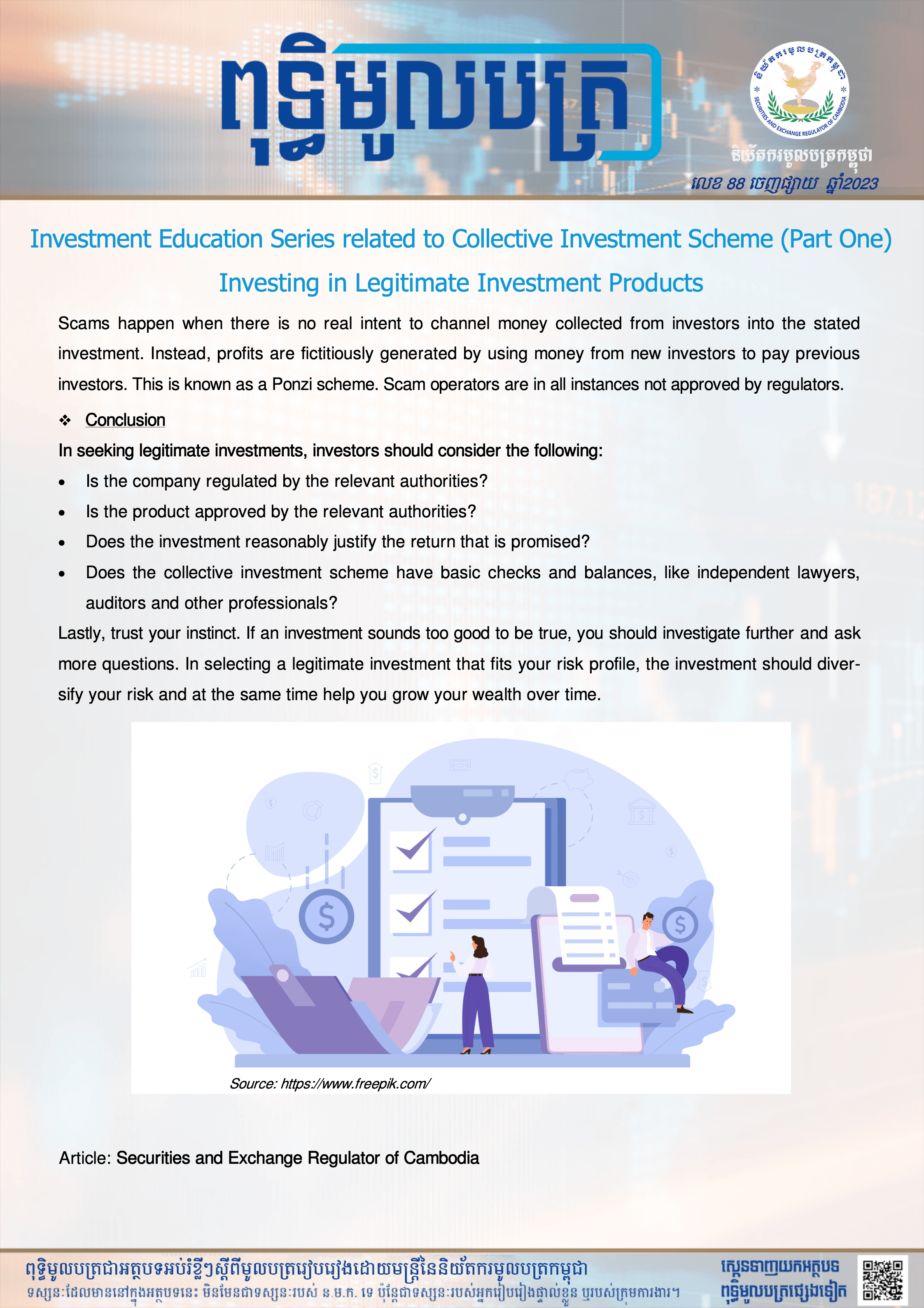
Scams happen when there is no real intent to channel money collected from investors into the stated investment. Instead, profits are fictitiously generated by using money from new investors to pay previous investors. This is known as a Ponzi scheme. Scam operators are in all instances not approved by regulators.
❖ Conclusion
In seeking legitimate investments, investors should consider the following:
Lastly, trust your instincts. If an investment sounds too good to be true, you should investigate further and ask more questions. In selecting a legitimate investment that fits your risk profile, the investment should diversify your risk and at the same time help you grow your wealth over time.
An article from the Securities & Exchange Regulator of Cambodia (SERC)
Related News
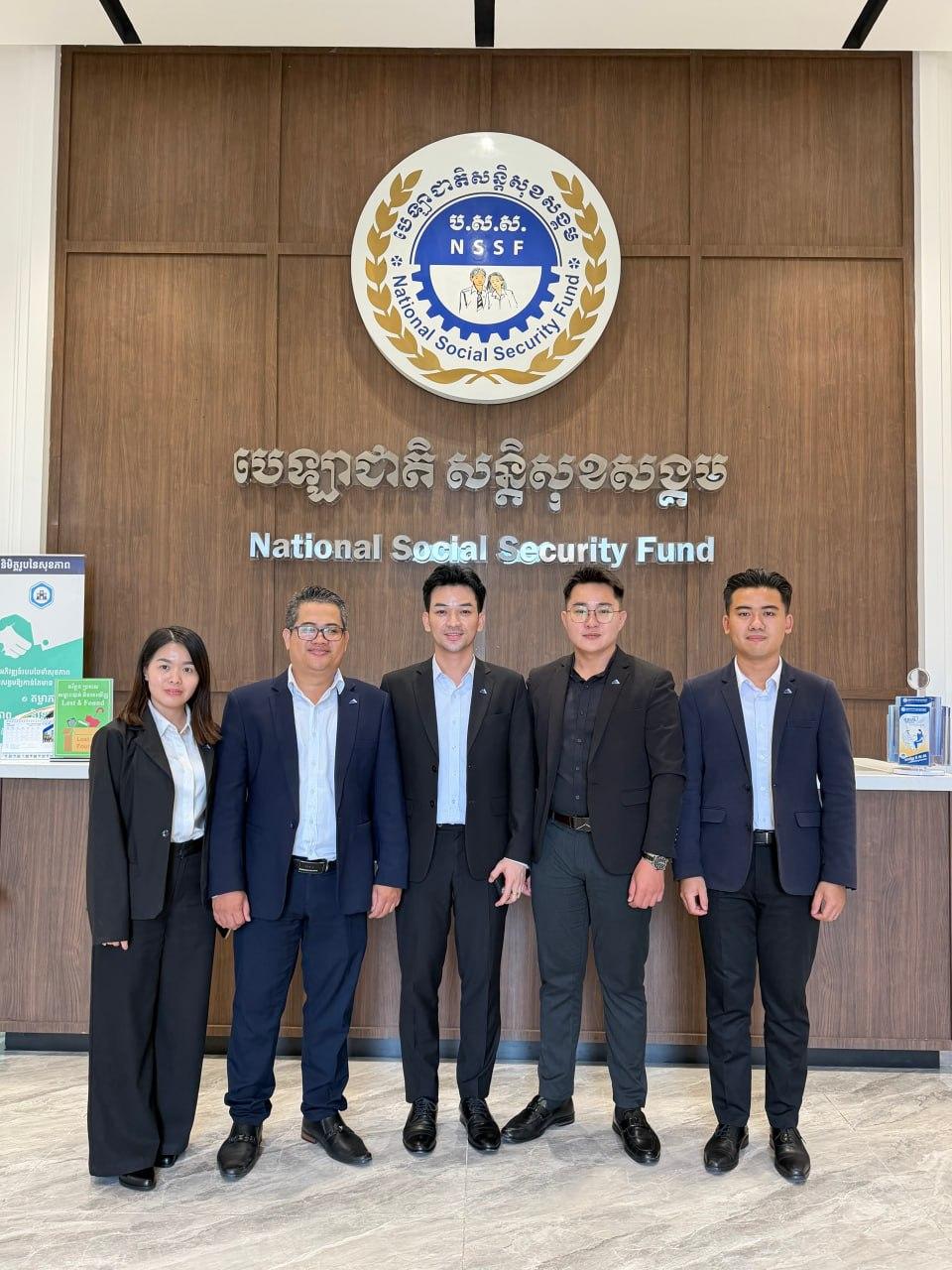
Training on Collective Investment Schemes (CIS) for National Social Security Fund Officials
On the afternoon of 9 June 2026, with the approval of the National Social Security Fund (NSSF) and under the assignment of the management of Banjaran Asset Management (Cambodia) Plc., Mr. Nhem Sopaul, Corporate Manager, led a team to conduct a training session on “Collective Investment Schemes (CIS)” for approximately 30 officials and staff members of the Department of Social Security Fund Investment Management of NSSF.

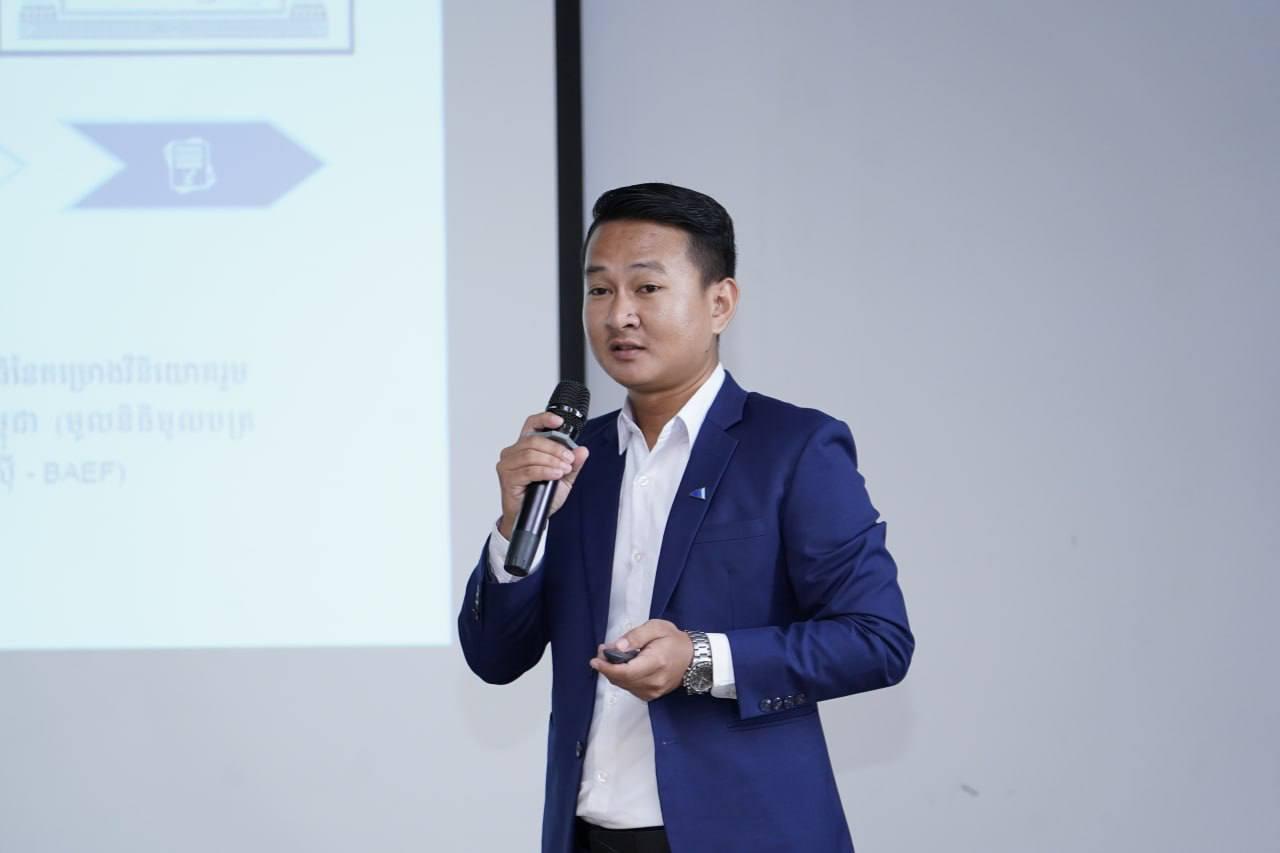
The Offering of the First Collective Investment Scheme Fund Units in Cambodia
The sharing session highlighted the establishment, registration, and offering process of BAMC Asia Equity Fund (BAEF), the first Collective Investment Scheme fund in Cambodia, as well as regulatory compliance, investor onboarding procedures, and operational experience in fund management within Cambodia’s securities sector.

Shaping Cambodia’s Financial Future: Insights from Industry Leaders
Mr. Eric Loo opened with an impactful presentation on “The Profound Significance of Successfully Launching Cambodia’s First Public Fund for the National Economy and Financial System”. He highlighted Banjaran AMC's footprint as a pioneer in the Cambodian market, discussing the challenges faced in introducing the country’s first public fund and the company high standards in setting to the industry to ensure transparency, security, and investor confidence.
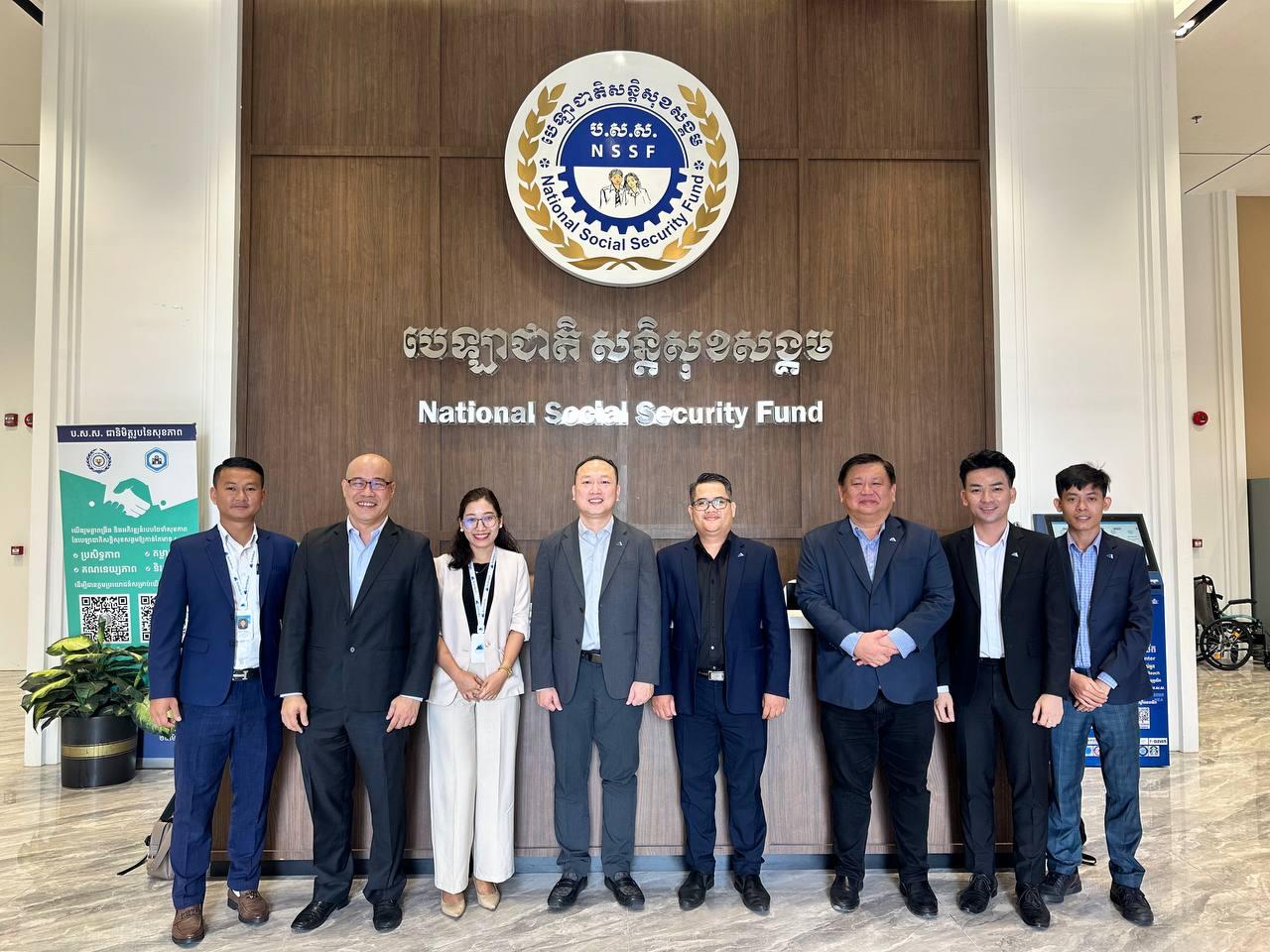
National Social Security Fund held an initial meeting to explore investment opportunities with Banjaran Asset Management (Cambodia) Plc.
The National Social Security Fund (NSSF) hosted a key delegation from Banjaran Asset Management (Cambodia) Plc., led by Mr. Eric Loo, CEO and Executive Director to discuss possible collaboration opportunities. The meeting was specially attended and led by two Board of Directors from Banjaran Asset Management Pte Ltd (BAMPL), Singapore.
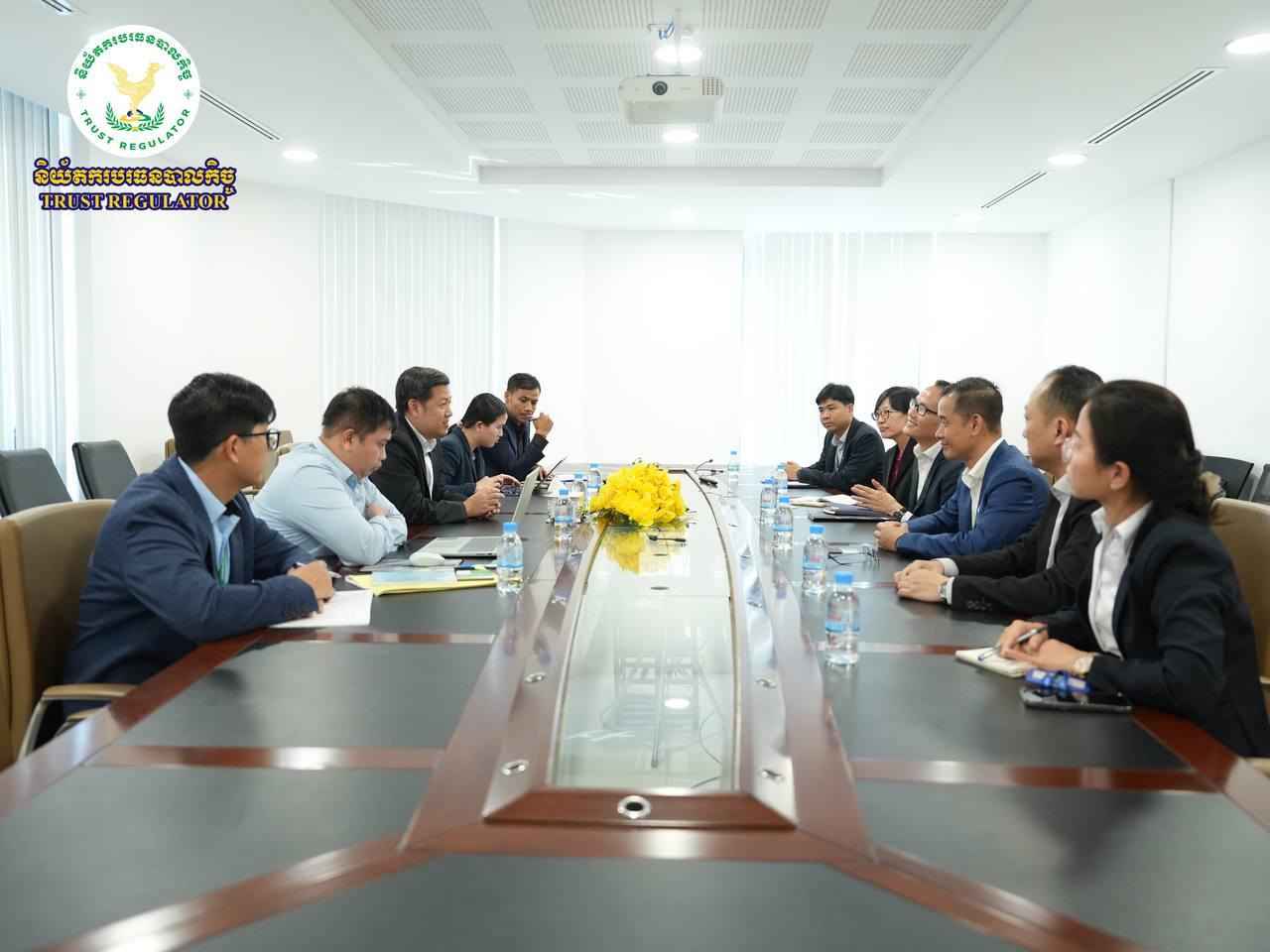
Mr. Eric Loo, CEO of Banjaran Asset Management (Cambodia) Plc., Participates in High-Level Meeting with Trust Regulator on Non-Bank Financial Sector Development
Phnom Penh, Cambodia – May 7, 2025 – Banjaran Asset Management (Cambodia) Plc., represented by its CEO, Mr. Eric Loo, alongside Lion Trust Group, held a pivotal high-level meeting with the Cambodia Trust Regulator (TR). Chaired by His Excellency Sok Dara, Director General of the TR, the session focused on advancing the non-bank financial sector and strengthening Cambodia’s regulatory framework. The strategic discussion highlighted a shared commitment between regulators and industry leaders to foster growth, innovation, and long-term trust in the Kingdom's financial ecosystem.

Banjaran Asset Management (Cambodia) Plc. at the Cambodia-ASEAN Business Summit 2025
The Cambodia ASEAN Business Summit 2025 will serve as a dynamic platform to foster economic cooperation and development within the ASEAN region, specifically showcasing Cambodia's growing role in regional economic integration. It is with great honor that the summit will be presided over by Samdech Moha Borvor Thipadei Hun Manet, Prime Minister of the Kingdom of Cambodia. Attendees will hear directly from the Prime Minister about the Royal Government’s commitment to supporting ASEAN businesses and fostering shared prosperity.