Insights
Article8 December 20235 min read

Investment Education Series related to Collective Investment Scheme (Part Two)

Investment Education Series related to Collective Investment Scheme (Part Two)

Why Invest and the Importance of Investment Diversification
Investment diversification across different asset classes would lower the risks compared to traditional investment portfolios. With the launch of the first Collective Investment Scheme (CIS), which was approved by the Securities and Exchange Regulator of Cambodia (SERC) recently, Cambodians now have
an opportunity to further protect their investments.

The CIS scheme now allows Cambodians to diversify their asset types into more legitimate investments across different countries which in turn lowers the risks.

A further line of protection is with the investments being carried out only with fund managers licensed by SERC. The SERC recently approved Cambodia’s first SERC-approved CIS fund – the BAMC Asia Equity Fund, managed by Banjaran Asset Management Cambodia.

Diversification of investment is not a new concept and is something that is propagated and recommended even by the world financial leaders.

According to the world’s 6th richest man and famous investor Warren Buffet, “Never depend on a single income. Make an investment to create a second
source”.

There are many benefits to investing whereby it helps wealth creation with investors making more money. For Cambodians, it also paves the way for financial independence, eventually leading to them not worrying about their financial stability. It can also be a solid source of additional income to top up
their regular income.

Importantly, it could also serve as a protection against inflation, giving the investor the freedom of affordability when prices of goods increase. The positive wealth-creation effect of investing is illustrated in Figure 1 below:

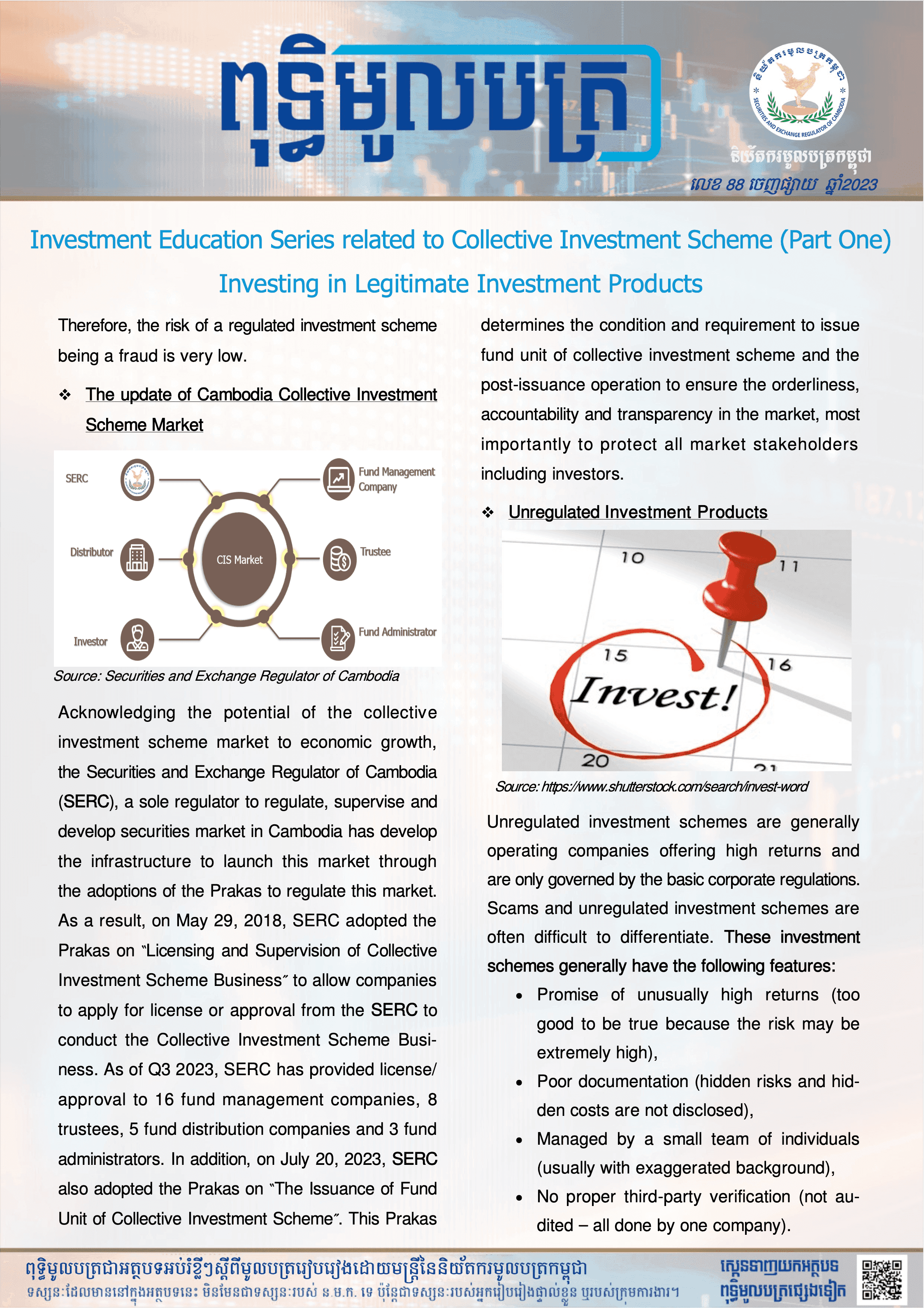
invest

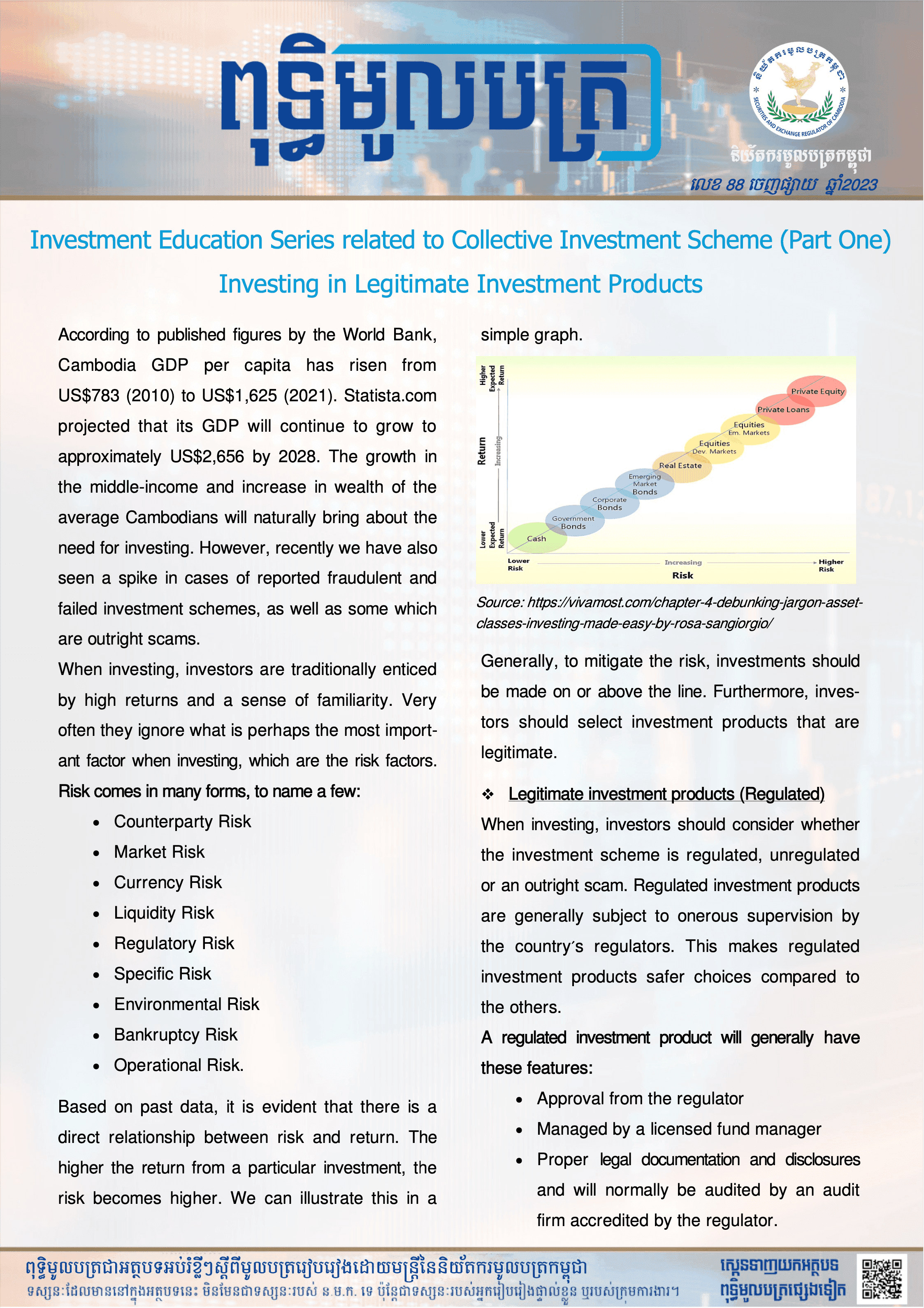
Investors, naturally would expect their assets to grow over time as they continue to maintain their investments. However, it is also important to note that all investments come with a certain amount of risk. The higher the return, the higher the risk.

These risks can be moderated through a simple action of diversifying the investment in the regulated financial products.

Currently, Cambodians tend to grow their wealth primarily through two forms of investments: bank fixed deposits and land-related investments. According to CEIC Data, in August 2023, Cambodia saw a record high of US$40.9 billion in total bank deposits. This was an increase from US$37 billion
recorded a year ago.

❖ Other Types of Investment

Screenshot 2024-09-26 at 15.42.18.png

There are many investment options available for investors, ranging from lower-risk investments like bank deposits and investment-grade bonds to the
extremely high-risk investments like private debt and private equities where investors may potentially lose all their invested capital.

❖ Investment Diversification
Investment diversification is the process of spreading your investments across different asset classes (bank deposits, stocks, bonds, real estate, etc), across different countries (HK/China, US, Japan, Singapore, Thailand, etc), and across different industry sectors (banking, consumer, technology,
property, etc). The main objective is to spread the risk such that if one investment goes bad, it should not affect the overall investment. When investments are diversified, the risk is lower.

In an equities collective investment scheme fund, for example, the risk of investing in stocks can be reduced through diversification. This is done by
creating a basket of stocks (known as a portfolio) comprising of 30 different stocks. The diversification benefits include not just from an increase in the
number of stocks invested, but also by investing in different countries and across different industry sectors such as banking, property, consumer,
telecoms, technology, etc. Through diversification by adding more stocks to a fund, the risk is greatly reduced.

The illustration below shows the diversification benefit-risk reduces as more stocks are added to the portfolio:

Screenshot 2024-09-26 at 15.45.24.png

One point to note is that while adding more stocks to a portfolio will reduce risk, it will come to a point where the residual risk cannot be further reduced
as more stocks are added. This residual risk is known as the market risk (indicated by * in Figure 3), which cannot be diversified away. An example of
market risk is when a major war breaks out, or a global pandemic that goes out of control, on a scale that is worse than COVID-19.

For an individual, it is troublesome to practice investment diversification. Firstly, the investment amount may be too small to diversify into different
asset classes, or to buy too many stocks. Secondly, transaction costs may be high and will affect the investment return as a result. Thirdly, the investor may not have time or knowledge to track the different investments and this may lead to taking no action as a result. And lastly, investors may lack the discipline to maintain proper investments.

Likewise, Cambodians generally should diversify their asset types into more legitimate investments. A good diversification would be to invest some in
fixed deposits, land-related investments, and collective investment scheme funds.

Collective Investment Scheme (CIS) fund collects monies from different investors and pools them together for investment purposes. Each investor
retains ownership and control of his own units in the fund. The fund then invests in assets like stocks, bonds, real estate, etc.

For an equities CIS fund, for example, a professional fund manager licensed by the SERC does the investment work. Investors can choose when to invest or exit the fund. Funds come with different investment strategies and objectives and appeal to different investors with different risk appetites. Investing in a CIS fund should offer investors an easy way to meet their investment and investment diversification objectives.

An investment fund offers multiple benefits. This includes it being professionally managed by a SERC-licensed fund manager and the fund is separately approved by the SERC for sale to the investing public.

It may offer diversification benefits as some CIS funds will invest in a diversified portfolio of stocks across different countries and different industry sectors

The initial investment amount can be set at an affordable level, for example as low as US$500. With this small amount of investment, an investor can own units in a portfolio of approximately 30 stocks or more. It also gives Investors the right to buy and sell the fund on a daily basis with the pricing of the fund being transparent and published daily in the local media.

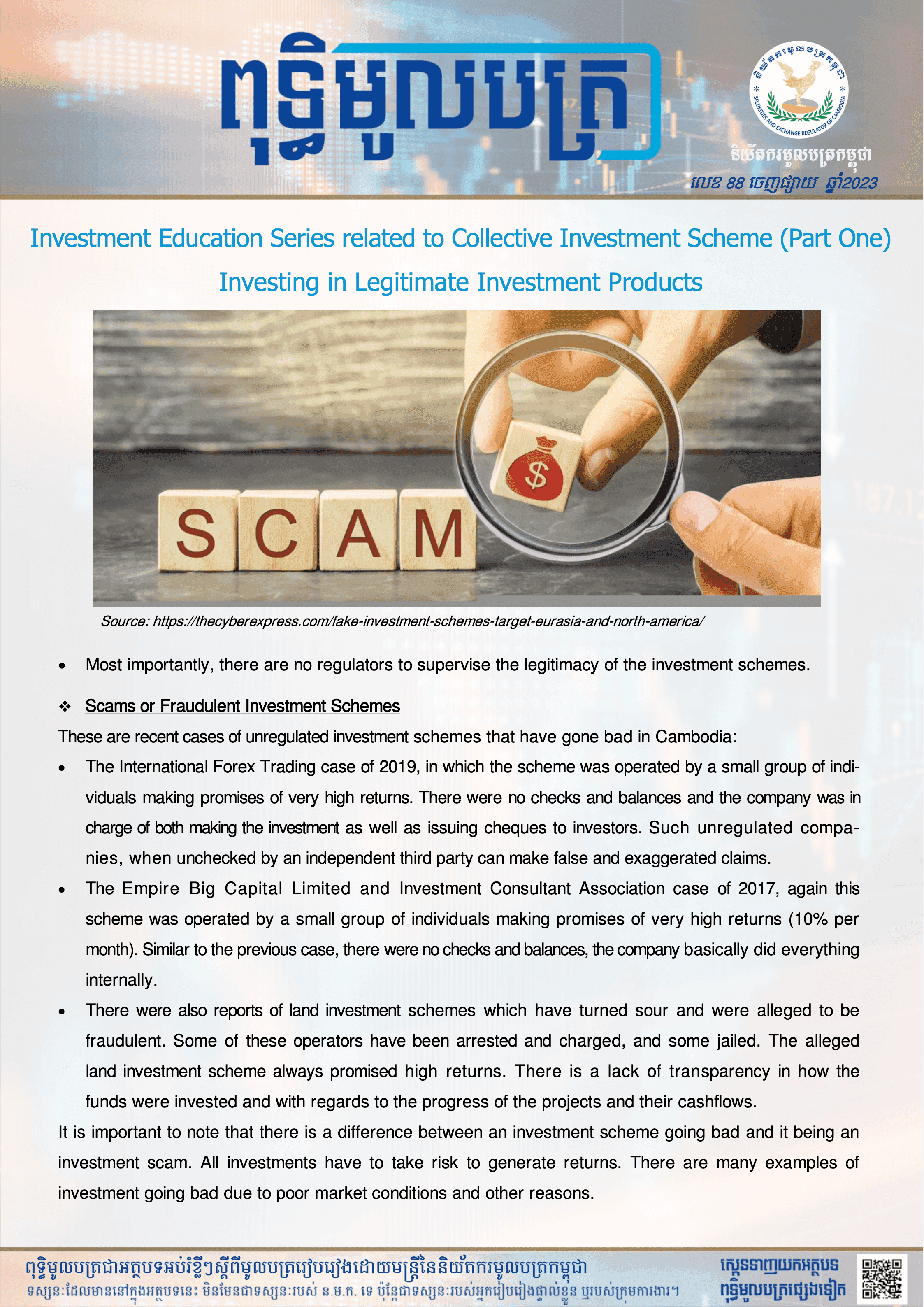
Investing should generate a reasonable, positive return with a manageable degree of risk. Individuals should generally invest in products that are regulated by the SERC, and managed by SERC-licensed fund managers. To be able to invest in a fund unit, the investor shall obtain the Investor Identification Number (ID) from the SERC first. Investors should also practice investment diversification to minimize investment risk. CIS fund offers investors the ease of investing, and also provides the other benefits from investment including diversification.

An article from the Securities & Exchange Regulator of Cambodia (SERC)
Share

More insights

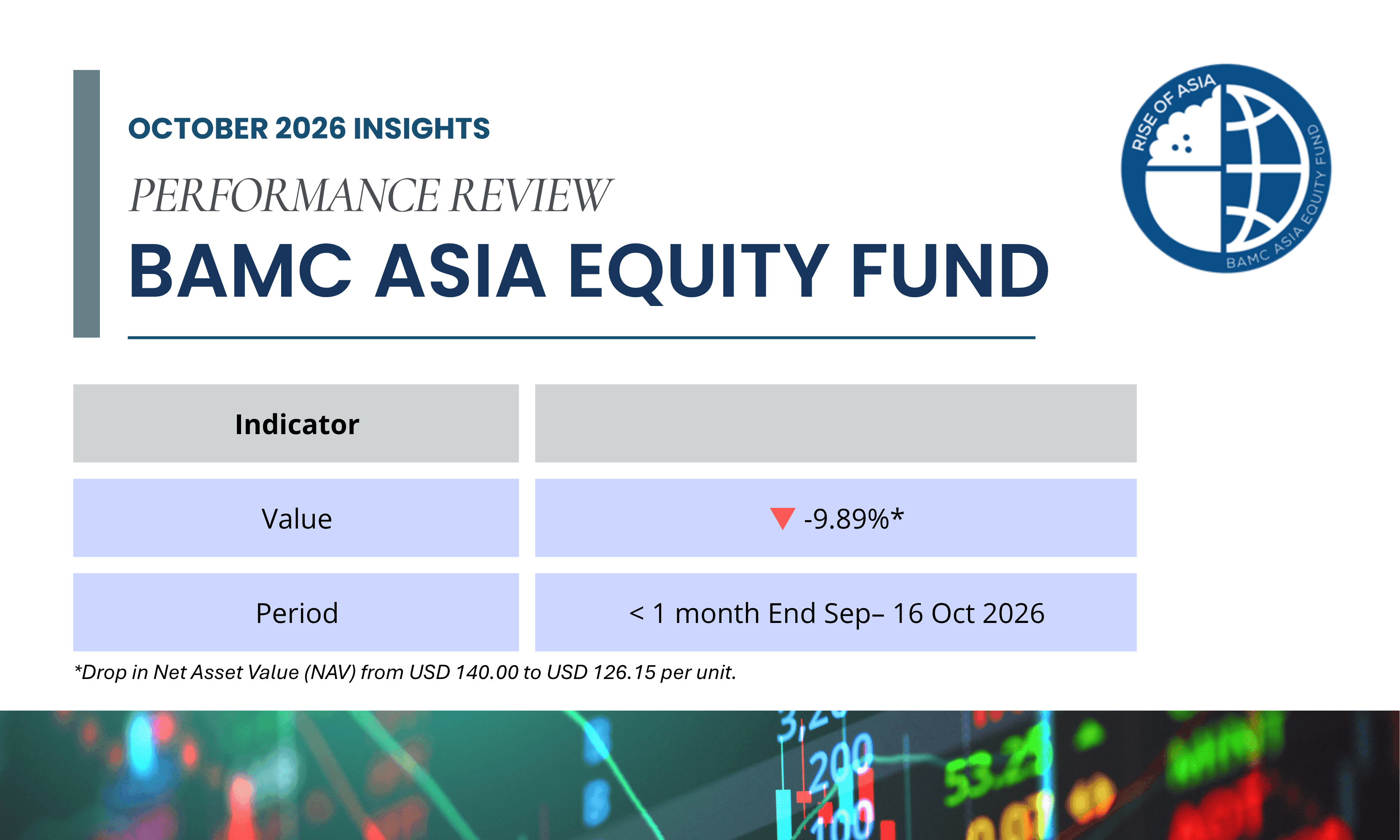
BAMC Asia Equity Fund (BAEF) Performance as of 16 October 2026
Announcement23 October 2026

BAMC Asia Equity Fund (BAEF) Performance as of 16 October 2026

Markets in October Since end September, global equities have faced pressure from higher borrowing costs and growing scrutiny of the returns from AI related spending. Stronger than expected US inflation reinforced expectations of further Federal Reserve tightening, weighing particularly on technology and semiconductor valuations. Elevated oil prices added further pressure on inflation concerns. Overall, technology-heavy Asian markets bore a greater share of the selling in October’s global tech weakness. Our exposure to Asian equities reflects our focus on the region’s long-term growth opportunities. Short-term volatility is an inherent risk of this approach, but our investment decisions remain anchored in companies’ fundamentals and their potential to generate sustainable returns over time. Portfolio underperformance Against this backdrop, BAEF’s main drag was its concentration in Korean and Taiwanese equities and semiconductor related holdings, which together accounted for 32.3% of the portfolio and approximately 4% of the calculated drag. The Korea ETF and Samsung alone contributed roughly 2%. Korea was particularly affected by the unwinding of AI-related positions. On 15 October, its benchmark equity index fell approximately 8%. Samsung’s weakness came despite guidance for a substantial increase in third-quarter operating profit, suggesting that concerns over valuations, financing conditions and competition outweighed the near-term earnings improvement. The drop was compounded by sharp falls in several Singapore small caps and financials. Addvalue fell 22.9%, UOB Kay-Hian 25.2%, OCBC 10.3%. OCBC faced a specific catalyst when Citi downgraded the stock from “neutral” to “sell”, citing risks to third-quarter earnings, pressure on net interest margins from higher deposit costs, and the potential normalisation of exceptionally strong first-half wealth-related income. Addvalue’s share price weakness is due to profit-taking after a strong run. Singapore’s semiconductor-related suppliers to chipmakers fell harder than the larger chipmakers; Frencken fell 14.9%, UMS 14.8% and AEM 9.9%. Together, these holdings constituted approximately 14% of the portfolio and implied another 2.3% of drag. Like the global technology sell-off, broader concerns over the AI investment cycle were weighing on sentiment beyond individual companies’ reported performance. There were few meaningful offsets in the portfolio as gains elsewhere were insufficient to counter the losses. Why we still hold these stocks Despite the recent weakness, we retain these holdings because the underlying earnings drivers remain relevant to our investment horizon. The sell-off has weakened share prices more than the underlying medium- to long-term investment case. In semiconductors, the correction has coincided with continued growth in demand for AI compute. TSMC’s latest results and guidance pointed to sustained demand for advanced chips, while Samsung’s earnings guidance reflected stronger memory sales and pricing. These developments support maintaining exposure to the sector, although we recognise that strong operating performance does not eliminate valuation risk or the possibility of further share price volatility. Our Singapore semiconductor holdings provide exposure to different parts of this investment cycle. UMS benefits from equipment demand and increasing exposure to advanced packaging, AEM offers participation in increasingly complex semiconductor testing, and Frencken provides a more diversified manufacturing exposure. The rationale for retaining these positions rests on their prospective earnings as customers invest in additional capacity and advanced chip architectures, rather than an expectation that all semiconductor-related stocks will recover together. For the financial holdings, recent operating results provide a basis for distinguishing share price weakness from deterioration in the businesses. OCBC’s wealth-management and other non-interest income have helped offset pressure on lending margins, while its capital position continues to support business growth and distributions. UOB Kay Hian reported substantially higher first-half earnings, supported by stronger trading activity, commission income and interest income. We retain exposure to these earnings streams, while recognising that wealth related revenue and brokerage activity are market sensitive and that recent growth rates may not persist. We retain exposure to Addvalue to the long-term growth in satellite connectivity and space infrastructure. Recent share-price weakness appears to reflect, in part, profit-taking following a strong rally, while continued orders support the underlying growth outlook. In september, Addvalue announced US$15 million of new orders across its space connectivity and advanced digital radio business, bringing its order book to US$20.2 million. Converting these orders into earnings and cash flow remains central to our investment case. Overall, we remain selective and view the decline as a potential opportunity to top up positions rather as a reason to hold every position unchanged. Continued ownership must be supported by company fundamentals, an acceptable valuation, and grounded in earnings growth. Moving forward Looking ahead, we intend to increase exposure to quality large-cap and blue-chip companies to strengthen portfolio resilience amid continued volatility. We will prioritise businesses with sound balance sheets, sustainable earnings and cash flows, and durable competitive advantages. Further market weakness could provide opportunities to build positions at more attractive entry prices, while maintaining a disciplined approach to valuation. Disclaimer : This Document is issued for information and investor awareness purposes only to explain the factors contributing to the changes in BAEF’s NAV. It does not constitute investment advice, an investment recommendation, an offer, or a solicitation to buy, sell, or hold units of BAEF. The information provided herein should not be relied upon as the sole basis for any investment decision and does not guarantee future performance. Investors should refer to the Fund’s official offering documents and disclosures and carefully assess their own investment objectives and risk tolerance before making any investment decision.

4 min readRead more
2026 September Market Outlook: Navigating Market Divergence
Market Outlook1 October 2026

2026 September Market Outlook: Navigating Market Divergence

The Fed maintained a restrictive, data-dependent stance through August and subsequently raised the federal funds target range by 25 basis points to 3.75-4.00% citing persistent inflationary pressures. Updated projections point to the possibility of one further increase in 2026. Elevated long-dated US Treasury yields continue to present a valuation risk particularly for growth, technology and AI-related companies, whose expected cash flows lie further in the future. At the same time, continued corporate earnings delivery and investments in strategic technologies along the tech supply chain have so far helped the global economy absorb tighter financial conditions. Strong earnings guidance from major global technology companies supports the view that investment in data centres, advanced chips and supporting infrastructure remains resilient. Within Asia, performance has diverged meaningfully across countries. Singapore remains the region’s defensible market, with strong banking profitability and wealth management inflows attracting investor interest amid global uncertainty. Taiwan and South Korea’s technology sector continues to be major beneficiaries of surging AI-related demand. On the other hand, confidence towards China’s and Indonesia’s growth outlook remains fragile. China’s slow economic momentum is a result of a weak property market and slow domestic consumption, while Indonesia’s commodity price normalisation and concerns over capital outflows weigh on sentiment. Against this backdrop, maintaining well-diversified exposure across geographies and themes remains important. We continue to be highly selective in stock selection, adhering to a disciplined, bottom-up approach to portfolio construction that prioritises quality and resilience to macroeconomic uncertainty.

1 min readRead more
Banjaran AMC Brings BAEF Investment Opportunities to Investors in Phnom Penh Through 3rd Round Roadshow
Roadshow5 September 2026

Banjaran AMC Brings BAEF Investment Opportunities to Investors in Phnom Penh Through 3rd Round Roadshow

Banjaran Asset Management (Cambodia) Plc. in collaboration with ACLEDA Securities Plc. and ACLEDA Bank Plc. Local Branch, (Khan Mean Chey, Sangkat Boeng Tumpun 01), successfully hosted the Workshop on “Golden Securities Investment by Opportunities” as part of the 3rd Round Roadshow. The workshop was held at the meeting hall of ACLEDA Bank Plc. Local Branch, (Khan Mean Chey, Sangkat Boeng Tumpun 01) on the morning of 05 September 2026. The workshop aimed to enhance public understanding of capital market investments and the BAMC Asia Equity Fund (BAEF), a Collective Investment Scheme (CIS). We sincerely appreciate the support of our partners and the active participation of all attendees. Special thanks to Mr. Sok Chantola, Deputy Sales & Marketing Manager of Banjaran Asset Management (Cambodia) Plc. on the topic “BAMC Asia Equity Fund (BAEF)”. We look forward to welcoming you to our upcoming events. #BanjaranAMC #BAEF #CIS #Investment #Strategic #Financial

1 min readRead more
2026 August Market Outlook: Navigating Volatility
Market Outlook1 September 2026

2026 August Market Outlook: Navigating Volatility

Concerns around the durability of AI-related capital expenditure and intensifying competition triggered a sharp sector sell-off after a mid-July peak. Investor sentiment turned more discerning on the back of earnings season, and questions arose regarding how sustainable the AI investment pace is without eating into cash generation. Capital rotated out of semiconductors and into energy, financials and value stocks, shifting to markets and names seen as less exposed to a single-theme correction. Layered on top was renewed Middle East escalation and its effect on rates expectations. Brent crude spiked back above $100/barrel intermittently after the US reinstated a naval blockade on Iran and announced plans to impose a levy on cargo transiting Hormuz, although the levy was never implemented. This revived inflation concerns and caused markets to price a reduced likelihood of further Fed easing. Elevated US bond yields further weighed on stocks. Looking ahead, renewed conflict or another AI-related pullback could swiftly unwind recent sentiment gains and force a repricing of both rates and earnings expectations. Against this backdrop, we continue to favour a diversified, bottom-up approach that balances exposure to structural AI and technology themes with quality, less crowded names to weather through volatility.

1 min readRead more
Banjaran AMC Expands Securities Investment Awareness Through 3rd Round Roadshow in Svay Rieng
Roadshow22 August 2026

Banjaran AMC Expands Securities Investment Awareness Through 3rd Round Roadshow in Svay Rieng

Banjaran Asset Management (Cambodia) Plc., in collaboration with ACLEDA Securities Plc., and ACLEDA Bank Plc. Local Branch (Svay Rieng Province), successfully hosted the Workshop on “Golden Securities Investment by Opportunities” as part of the 3rd Round Roadshow. The workshop was held at the meeting hall of ACLEDA Bank Plc. Local Branch (Svay Rieng Province) on the morning of 22 August 2026. The workshop aimed to enhance public understanding of capital market investments and the BAMC Asia Equity Fund (BAEF), a Collective Investment Scheme (CIS). We sincerely appreciate the support of our partners and the active participation of all attendees. Special thanks to Mr. Taing Hoy, Legal and Compliance Officer of Banjaran Asset Management (Cambodia) Plc., on the topic “Investment Value and Benefits of the BAMC Asia Equity Fund (BAEF)”. We look forward to welcoming you to our upcoming events. #BanjaranAMC #BAEF #CIS #Investment #Strategic #Financial

1 min readRead more
Banjaran AMC Strengthens Strategic Partnership with Forte Through BAEF Investment Workshop
Event19 August 2026

Banjaran AMC Strengthens Strategic Partnership with Forte Through BAEF Investment Workshop

Banjaran Asset Management (Cambodia) Plc., in collaboration with ACLEDA Securities Plc., successfully organized a workshop on “Golden Investment Opportunities in Securities Sector” for the Management team and staff of Forte General Insurance Plc., and Forte Life Assurance Plc., on 19 August 2026 at Forte Office, One Park Tower. The workshop provided participants with valuable insights into the BAMC Asia Equity Fund (BAEF), including its key features, investment strategy, and the opportunities available through investing in a professionally managed fund licensed by the Securities and Exchange Regulator of Cambodia (SERC). During the session, Mr. Sok Chantola, Deputy Sales & Marketing Manager of Banjaran Asset Management (Cambodia) Plc., delivered a presentation on “Investment Value and Benefits of the BAMC Asia Equity Fund (BAEF)”, sharing knowledge on investment opportunities and the benefits of BAEF as part of Cambodia’s growing securities sector. This workshop marks another important milestone under the Strategic Partnership between Banjaran Asset Management (Cambodia) Plc., ACLEDA Securities Plc., Forte General Insurance Plc., and Forte Life Assurance Plc., with the aim of enhancing investment awareness, strengthening collaboration, and creating opportunities for future business growth. #BanjaranAMC #BAEF #CIS #Investment #Strategic #Financial

1 min readRead more